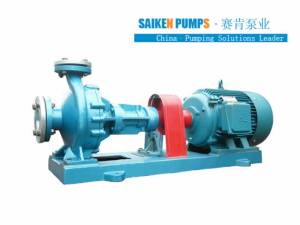
RY Hot Thermal Oil Pump Centrifugal type

RY Hot Thermal Oil Pump Centrifugal type
Qmax to 500m3/h, Hmax to 80m, hot oil pump, max temp 400C degree
The Saiken RY pump is a kind of thermal oil pump, it is designed to handle thermal oil up 350°C temperature. RY series pumps are of centrifugal, single stage, horizontal shaft type. Self-balancing impeller by rear impeller blades. No cooling of the seal chamber required. Generally the pump is driven by an electric motor coupled to the pump by means of an elastic coupling. It is possible to fit a flexible spacer coupling so as to dismantle the complete pump support without removing pump casing and motor from the base plate. The coupling is protected by a cover, so as to prevent external intrusion.

RY Hot Thermal Oil Pump Centrifugal type

How to use heat transfer oil pump

In order to ensure the full performance of the heat transfer oil pump and a good service life, the following aspects should be paid attention to when using the hot oil pump:

1. Turn on the switches of related instruments;

2. Connect the power supply. When the pump reaches the normal speed and the meter shows considerable pressure, gradually open the gate valve on the output pipeline and adjust it to the required working condition. When the gate valve on the output pipeline is closed, the pump can not work continuously for more than 3 minutes;

3. Connect the power supply. When the pump reaches the normal speed and the meter shows considerable pressure, gradually open the gate valve on the output pipeline and adjust it to the required working condition. When the gate valve on the output pipeline is closed, the pump should not work continuously for more than three minutes or four. At the beginning of operation, slowly heat the equipment in the production process to 100-130 degrees, and keep the Hot oil circulating pump at this temperature to continue running , The water in the heat transfer oil from dehydration and degassing is completely evaporated before the equipment is heated to the operating temperature;

4. During the first 3-4 hours of operation, turn off the oil pump after heating the equipment to operating temperature, check the coaxiality of the pump shaft and motor shaft coupling, and control the deviation of the pump shaft and motor shaft within the allowable range. The pump shaft should be rotated by hand, flexible and vibration-free. If the SS hot oil pump fails to meet the above requirements, it should be re-adjusted;

5. After running for 3000 hours, each ball bearing must be removed and cleaned with diesel oil, and then checked for damage. If it is damaged, a new bearing must be replaced;

6. When installing by the ball bearing on the impeller side, the side with the dust cover of the hot oil pump should be installed toward the impeller, and lubricate with heat transfer oil before driving;

7. The ball bearing on the coupling side uses compound calcium-based high-temperature grease. When the bearing is reinstalled, the side with the dust cover of the hot oil pump should also be installed toward the impeller side, and filled with grease during installation.

8. During the start-up process, always pay attention to the power reading and vibration of the motor, and the vibration value should not exceed 0.6 mm. If there is any abnormality, stop and check;

Heat transfer oil pumps are mainly used in petroleum and chemical industries; grease industry; synthetic fiber industry; textile printing and dyeing industry; plastics and rubber industry; paper industry; wood industry; construction industry, machinery industry, food industry, pharmaceutical production, and hot oil heating cycle systems. application.

Hot oil circulating pump
RY air-cooled hot oil circulation pump is a kind of ideal hot oil circulation pump or heating body pump, is an ideal heat equipment supporting pump. RY type high temperature heat conduction oil pump reasonable structure, good performance, reliable operation. The heat conduction oil pump is suitable for conveying not containing solid particles of high temperature liquid. The corrosion degree and using temperature depends on the contact with the media of the main components of the material. High temperature heat conduction oil pump use of self heating and cooling structure, change the traditional water cooling structure, make simple structure, small volume, save operating cost, good performance, the use of reliable, is our country the digestion and absorption of foreign oil pump developed on the basis of the second generation product.

Heat transfer oil pump: “Some precautions for heat transfer oil heating”!

The heating of the heat transfer oil is to meet the production requirements. The working temperature of the high temperature heat transfer oil is slowly raised to the production process temperature under the allowable temperature. The heat transfer oil can be heated up only after the oil is boiled and dehydrated, because with the discharge of the gas in the heat transfer oil system and the replenishment of the heat transfer oil, the working pressure of the heat transfer oil pump circulating pump and the pressure difference between the inlet and outlet of the heating furnace make the heat transfer oil worse. The flow is gradually normal and stable. Under this premise, the working temperature of the heat transfer oil can be gradually increased.

1. The first heating rate should not be too fast, it should be carried out according to the heating curve, the heating rate is about 20 degrees Celsius per hour.

2. In the process of heating up, check the operating conditions of the equipment and process system back and forth, whether the heat transfer hot oil pump has noise or vibration, and whether the lubrication is normal.

3. Carefully check the pipeline valve for leaks and dripping.

4. In the process of heating up, carefully check whether the support of the process system and pipeline is stable or not.

5. Comprehensively check the thermal expansion of the pipeline during the heating process.

6. In the process of heating up, check whether various process parameters are normal at any time, such as pressure difference, temperature, flow, temperature difference and pressure.

7. In the process of heating up. The temperature difference should not be too large, and the pressure difference should not be too small. The heat conduction oil pump must have a good operation record of the heating furnace debugging.

8. Carefully check whether the action of the electrical instrument and its control alarm device is correct during the heating process.

Manufacturers and suppliers of hot oil pumps in China

Hot oil circulating pump
The main parts of pump includes: pump casing, impeller, and shaft seal and so on. There is high temp glad packing in the pump sides and a high temp oil seal in the motor sides. The pump is driven by the motor through an elastic coupling.
With the natural cooling model, the pump is in simple structure, small size and easy maintenance.If the medium temperature higher than 250°C,need to add water cooling system.

Installation and application of high temperature heat transfer oil pump and matters needing attention

The installation and application of the heat transfer oil pump, in the use of the site, often use errors, let’s take a look at the installation and application of the heat transfer oil pump.

The following points need to be paid attention to when installing the heat transfer oil pump:

1. The installation height of the inlet of the heat transfer oil pump should not exceed 1 meter. If conditions permit, the suction inlet should be as low as possible below the low water storage surface of the pool.

2. When installing the pipeline, the length of the suction pipe should be shortened as much as possible, and the use of elbows should be reduced (this will help shorten the self-priming time)

3. Check the valves and flanges in the suction pipeline in advance to avoid air leakage or liquid leakage.

4. Appropriate filters must be installed in the suction pipeline to prevent inhalation of solids and other debris in the pump body. Note: The effective water area of ​​the filter should be 2~3 times the cross-sectional area of ​​the suction pipe diameter; the filter should be checked and replaced regularly.

Application of heat transfer oil pump:

Large flow high temperature heat transfer oil pump due to its large volume and large conveying flow, so the quality of the pump must be passed and the pump stability must be high.

Manufacturers and suppliers of hot oil pumps in China

Saiken Pump Industry Seiko builds Hot oil circulating pump


hot oil pump
BRY type Hot Oil Thermal Liquid pumps is coupling type circulation pump for transferring the high temperature conduction oil. The entrance of the pump is axial suction, the exit is vertical center. Transferring medium is conduction oil without the particle and fiber.

Centrifugal hot oil pump supplier from china

Heat centrifugal hot oil pump series is designed for circulating liquids or heat transfer media such as thermal oils (up to 700F) or hot water (up to 350F) in process systems. The centrifugal hot oil pump design is a single-flow‚ single-stage‚ volute pump available with a shaft seal or magnetically-coupled pump without a shaft seal. In a centrifugal pump‚ the process liquid enters through the suction nozzle and then the center of pump known as the impeller. As the impeller rotates‚ it spins the liquid sitting in the cavities between the vanes outward. As the liquid leaves the eye of the impeller a low-pressure area is created causing more liquid to flow toward the inlet. The faster or bigger the impeller‚ the higher the velocity of the liquid at the vane tip and the greater the energy imparted to the liquid.

Thermal Oil Pumps & Hot Oil Circulating Pumps for heat-transfer oils | China saiken Pumps
Thermal oil pumps also called hot oil pumps, are designed for the movement of heat-transfer oils under high temperature conditions
Magnetic drive hot oil pumps - Saiken Pumps
The magnetic drive centrifugal hot oil pumps uses magnetic drive to realize the contactless transmission of torque,Suitable for transfer of high temperature hot water,HEAT-TRANSFER OIL,methanol,glycol,potions,low temperature liquid oxygen,and other me

What are the requirements for the installation of the pump body and end cover of the stainless steel gear pump

1. Stainless steel gear pump body castings must not have pores, trachoma, slag inclusion, cracks, and other defects
2. The machined surface of the stainless steel gear oil pump body should be smooth without traces and grooves. If there is slight roughness or scratches, a semi-circular oil stone can be used to repair the center line of the inner hole and the straightness of the vertical surface at both ends.
3. The water pressure test is 1.5 times of the working pressure, keeping 5Min without leakage
4. The surface of the end cover bracket must not have any defects such as air holes, trachoma, slag inclusion, cracks, etc.
5. Measure the balance of the two hollow axes of the end cover, which should be no more than 0.01%, and the deviation of the hole and center distance is +-0.04mm, and the straightness of the center line of the end cover hole and the processed surface should be no more than 0.03%.
6. When assembling, the bolts should be evenly tightened while rotating the rotor. If the rotor does not move, adjust the gap and tighten again.

China gear oil pump manufacturer and supplier

Saiken Pumps Seiko builds SS gear pumps

 stainless steel gear pump
Heavy-duty construction optimized for rare maintenance. Produced in different versions depending on the specific application. Used by transfer, dosage, processing, load and unload. In chemical, ink, paint, construction, chocolate and oil-industry, in refineries and storage facilities.

Where is the stainless steel gear pump used

1.The stainless steel gear pump can be used as a transmission and booster pump in the oil delivery system; it can be used as a fuel pump for delivery, pressurization and injection in the fuel system; it can be used as a hydraulic pump to provide hydraulic power in the hydraulic transmission system; Can be used as lubricating oil pump in all industrial fields;

2. Used as a polyester metering pump in the chemical fiber industry

3. In the chemical industry, the gear material is changed to stainless steel, which is used to transport more viscous chemical media.

China gear oil pump manufacturer and supplier

Saiken Pumps Seiko builds stainless steel gear oil pumps

Stainless steel gear pump
Saiken pumps supply of rotary gear pump heads and pedestal gear pumps to help keep your business operating efficiently. Choose from light-, intermittent-, heavy-, chemical-duty and high-temperature pump heads made from 316 stainless steel/304 stainless steel , bronze and cast iron. Rotary gear pedestal pumps can help transfer nonabrasive or nonparticulate viscous liquids with a continuous, near-pulseless flow. Shop Grainger for durable, reliable rotary gear pump heads and pedestal gear pumps

What are the models of stainless steel gear pumps?

Stainless steel gear pump is a rotary pump that relies on the change and movement of the working volume formed between the pump cylinder and the meshing gear to transport liquid or pressurize it. Two enclosed spaces are composed of two gears, a pump body and front and rear covers. When the gears rotate, the volume of the space on the side of the gear disengagement increases from small to form a vacuum to suck liquid in, and the volume of the space on the gear mesh side increases from large Small, and squeeze the liquid into the pipeline. The suction cavity and the discharge cavity are separated by the meshing line of the two gears. The pressure at the outlet of the gear oil pump depends entirely on the resistance at the outlet of the pump.

China gear oil pump manufacturer and supplier

SUS gear oil pump
Gear pumps are used or have a potential in all types of industries such as:
Petrochemicals Pure or filled bitumen, pitch, diesel oil, crude oil, lube oil Chemicals Sodium silicate, acids, plastics, mixed chemicals, isocyanates Paint and Ink Resins and Adhesives
Pulp & Paper Acid, soap, lye, black liquor, kaolin, lime, latex, sludge
Food Chocolate, cacao butter, fillers, sugar, vegetable fats and oils, molasses, animal feed.


What are the advantages of stainless steel pumps

The stainless steel gear pump has a compact structure and a small footprint. The stainless steel pump can be directly installed in the sewage tank because it is submerged in the liquid. There is no need to build a special pump room to install pumps and machines, which can save a lot of land and infrastructure costs. Easy maintenance of stainless steel pump unit. Small SS gear pumps can be installed freely, and large stainless steel gear pumps are generally equipped with automatic coupling installations that can stop automatic devices. The installation and maintenance are quite convenient. The stainless steel pump runs continuously for a long time. Due to the coaxial pump and motor, the Botou stainless steel gear pump has a short shaft and light weight of rotating parts, the load (radial) on the bearing is relatively small, and the service life is much longer than that of ordinary pumps. Ⅳ. The stainless steel pump has no problems such as cavitation damage and water diversion. Especially the latter point brings great convenience to the operators. But everything is divided into two. The most critical issue for stainless steel pumps is usability. Because stainless steel pumps are used under liquid; the conveying medium is some mixed liquid containing solid materials; pumps and motors Very close; the pump is a vertical arrangement, and the weight of the rotating parts is in the same direction as the impeller receiving water pressure. These problems make stainless steel gear pumps have higher requirements than ordinary sewage pumps in terms of sealing, motor load capacity, bearing arrangement and selection.

SS Gear Pump
NYP Stainless Steel Rotary Gear Pump is a kind of new positive displacement pump, and is designed according to the different fields of petroleum, chemical industry, paint, medicine, foodstuff and so on. It widely applies to a variety of mediums with different property and viscosity because of special structure and selected different pumps’ materials.If pumping hazardous, hard-to-handle liquids and for applications, the pump can be fitted with a magnetic driver – NYP Mag-Drive Internal Gear Pump.
The SS Gear Pump non pulsating constant flow, therefore no vibrations on fittings, valves or couplings. Full performances are available in either direction of rotation. It can also be requested with heating jackets, with ports at 90° or 180°.

Gear Pumps – External and Internal gear pump china

Gear pumps are a type of rotary positive displacement pump, meaning they pump a constant amount of fluid for each revolution.
Gear pumps transfer fluid by gears coming in and out of mesh to create a non-pulsating pumping action. Gear pumps are able to pump at high pressures and excel at pumping high viscosity liquids efficiently.
Gear pump according to the material can be stainless steel 304 316 316L, carbon steel, cast iron, cast steel
Gear pumps can be into interna gear pump and external gear pump according to the structure, internal gear pump is also known as NYP high viscosity rotor pump in china, similar to the VIKING PUMP in the USA,Internal gear pump designs only use spur gears, This pump has been widely used mainly in three kinds of media:

*Fluids that are pure and have a certain degree of viscosity, such as lube oil and crude oil.
*High-viscosity materials that contain no particles, like rubber, asphalt, paint, adhesives, dyes, lubricants, polyols, food and medicine.
*High-temperature and high-viscosity polymers, like PA, PB, PC, PE, PS, HIPS, ABS, PP, PET and PVA.

External Gear Pump there are many models in China, such as Kcb Gear pump, YCB Gear pump, 2cy Gear pump, etc
These Pump is a higher flow, Low pressure external gear pump. Designed for the transfer of lubricating fluids with varying viscosities up to 1500cSt, designed for handling larger volumes of fuels and lubricating oil, Diesel, kerosene and so on

What are the main features and advantages of gear pumps?
The gear pump is compact and simple, with a limited number of moving parts. They cannot match the pressure generated by reciprocating pumps or the flow rate of centrifugal pumps, but they provide higher pressure and throughput than vane pumps or lobe pumps. Gear pumps are particularly suitable for pumping oil and other high viscosity fluids.

In both designs, the external gear pump can withstand higher pressures (up to 3000 psi) and flow due to stronger shaft support and smaller tolerances. Internal gear pumps have better suction capacity and are suitable for high-viscosity fluids, although their useful working range is from 1cP to 1,000,000cP or more. Since output is proportional to speed, gear pumps are often used for metering and mixing operations. Gear pumps can be designed to handle corrosive liquids. Although they are usually made of cast iron or stainless steel, new alloys and composite materials enable the pump to handle corrosive liquids such as sulfuric acid, sodium hypochlorite, iron chloride and sodium hydroxide.

External gear pumps can also be used in hydraulic power applications, usually in vehicles, cranes and mobile factory equipment. Using oil pumped from other locations in the system (usually by tandem pumps in the engine) to drive the gear pump in reverse, will produce a hydraulic motor. This is particularly useful for providing power in areas where electrical equipment is heavy, expensive or inconvenient. For example, tractors rely on engine-driven external gear pumps to power their services.

What are the limitations of gear pumps?
The gear pump is self-priming and can be dry-lifted, although it will improve its oil absorption characteristics if the gear gets wet. The gears need to be lubricated with pumped liquid and should not be idling for a long time. For example, some gear pump designs can run in either direction, so the same pump can be used to load and unload the container.

The tight tolerance between the gear and the housing means that these types of pumps are prone to wear, especially when used with abrasive liquids or feeds that contain entrained solids. However, certain designs of gear pumps, especially internal variants, allow the handling of solids. The external gear pump has four bearings in the pumped medium and has strict tolerances, so it is not suitable for handling abrasive fluids. Internal gear pumps are more robust, with only one bearing (sometimes two) running in the fluid. The gear pump should always install a filter on the suction side to prevent it from attaching to large, possibly damaging solids.

Generally, if you want the pump to be able to handle abrasive solids, it is recommended to choose a pump with a larger capacity so that it can run at a lower speed to reduce wear. However, it should be remembered that the volumetric efficiency of gear pumps will decrease at lower speeds and flows. The operating speed of the gear pump should not exceed the recommended speed.

For high temperature applications, it is important to ensure that the operating temperature range is compatible with the pump specifications. The thermal expansion of the housing and gears reduces the clearance in the pump, which also leads to increased wear and, in extreme cases, to pump failure.

Despite the best precautions, gear pumps usually wear gears, housings and bearings over time. As the gap increases, the efficiency will gradually decrease and the flow direction slip will increase: the pumped fluid leaks from the discharge port back to the suction side. The flow slip is proportional to the cube of the gap between the gear teeth and the sleeve. Therefore, in practice, the effect of wear is small until it reaches a critical point, from which the performance will rapidly decrease.

The gear pump continues to pump to the back pressure, and if it is blocked downstream, it will continue to pressurize the system until the pump, pipeline or other equipment fails. Although for this reason, most gear pumps are equipped with safety valves, it is always recommended to install safety valves elsewhere in the system to protect downstream equipment.

For shear-sensitive liquids (such as food, paint and soap), internal gear pumps running at low speeds are usually preferred. The higher speed and lower clearance of the external gear design make them unsuitable for these applications. When hygiene is important, internal gear pumps are also preferred because of their mechanical simplicity and the fact that they are easy to disassemble, clean and reassemble.

What is the main applications of the gear pump?
Gear pumps are usually used to pump high-viscosity fluids such as oil, paint, resin or food. They are the first choice for any application that requires precise metering or high voltage output. The output of gear pumps is not greatly affected by pressure, so they tend to use gear pumps in any irregular supply.

The following table lists some typical applications of external and internal gear pumps:

Type of gear pump External Internal 
Various fuel oils and lube oils
Chemical additive and polymer metering
Chemical mixing and blending
Industrial, agricultural and mobile hydraulic applications
Acids and caustic (stainless steel or composite construction)
Resins and polymers
Alcohols and solvents
Asphalt, bitumen, and tar
Polyurethane foam (Isocyanate and polyol)
Food products: corn syrup, peanut butter, cacao butter, chocolate, sugar, fillers, vegetable fats, vegetable oils, animal feed
Paint, inks, and pigments
Soaps and surfactants
Glycol


Summary
The gear pump moves fluid by repeatedly enclosing a fixed volume in interlocking gears or gears, and mechanically transmits it to deliver a smooth, pulse-free flow proportional to the speed of the gear. There are two basic types: external and internal. The external gear pump consists of two identical interlocking gears and is supported by an independent shaft. The internal gear pump has two interlocking gears of different sizes, one interlocking gear rotates inside the other.

Gear pumps are usually used to pump high-viscosity fluids such as oil, paint, resin or food. They are also the first choice in applications requiring precise dosing or high-voltage output. External gear pumps can withstand higher pressures (up to 2.5Mpa), while internal gear pumps have better suction and are more suitable for high viscosity and shear-sensitive fluids.